
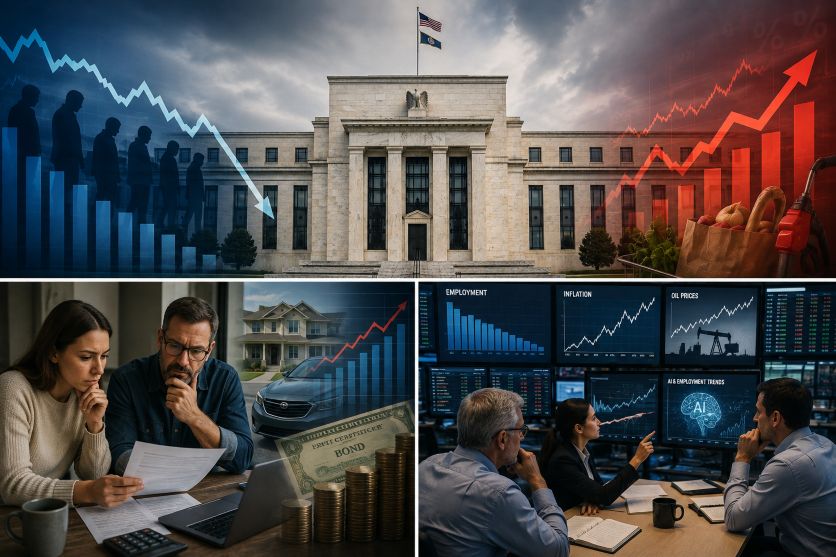
U.S. payroll employment fell by 23,000 jobs in July 2026, creating a difficult backdrop for the Federal Reserve just as inflation remains well above its 2% goal. Data from the U.S. Bureau of Labor Statistics also showed unemployment holding at 4.1%, while earlier months were revised lower. Meanwhile, the Fed’s preferred inflation measure, the PCE price index, rose 3.7% over the year through July.
That combination sends monetary policy in opposite directions. Weak hiring normally gives the Fed a reason to lower rates or avoid further increases. Persistent inflation argues for tighter policy. Markets are therefore watching the August employment report, due September 4, closely. Recent trading has moved toward another increase, with Reuters reporting that investors put the probability of a September hike near 60% following Fed Chair Kevin Warsh’s latest comments.
Why Weak Jobs Usually Point Toward Lower Rates
The Federal Reserve has a dual mandate: maximum employment and stable prices. When hiring weakens sharply, higher borrowing costs can make the slowdown worse. The Federal Reserve explains that lower interest rates can encourage households to borrow and companies to invest, expand and hire. Higher rates generally do the reverse.
That matters beyond the job market. A softer rate path could eventually ease pressure on mortgages, auto financing and business loans. It can also reduce returns on some savings products. Bond prices may benefit when market interest rates decline, while investors may become more willing to hold stocks or other riskier assets.
But Inflation Is Still Blocking an Easy Pivot
Inflation changes the calculation. The Federal Reserve reported in July that price pressures had risen partly because of energy shocks and tariffs. Raising rates can restrain demand and help prevent persistent price increases from becoming embedded in expectations.
Consumers feel this trade-off directly. Higher policy rates can mean more expensive variable-rate credit and tougher borrowing conditions. Businesses face a similar squeeze. The Fed reported that households and small businesses were already experiencing relatively tight credit conditions during the first half of 2026.
What Changes When Old Economic Relationships Become Messier?
Several forces are complicating the usual connection between jobs and inflation. Oil prices have risen amid Middle East tensions, adding another potential source of price pressure. Tariffs can raise the domestic cost of imported goods. Heavy government borrowing can push Treasury yields higher, influencing mortgage and corporate borrowing rates even without a Fed move. Reuters recently reported that rising government borrowing, inflation risks and geopolitical uncertainty were contributing to higher long-term yields.
Artificial intelligence adds another unknown. Research from the Federal Reserve says AI adoption could automate some work, raise productivity and create new occupations, but its long-term employment effects remain uncertain. That makes weak hiring harder to interpret because technological restructuring may be occurring alongside ordinary economic slowing. {index=6}
Which Signals Will Decide the Fed’s Next Move?
The August jobs report will be important, but it will not settle the debate alone. Policymakers will also watch unemployment, wage growth, labor-force participation, PCE inflation, consumer spending and inflation expectations. Oil prices and Treasury yields matter too. If employment continues weakening while inflation finally cools, pressure for easier policy should increase. If prices remain stubborn despite slow hiring, the Fed may decide that controlling inflation still requires tighter financial conditions.
For households, businesses and investors, that means the next Fed decision depends less on one headline number than on which trend becomes clearer first: a weakening economy or inflation that refuses to return to target.